Chronic pain is rarely a simple readout of tissue damage; once pain persists, the brain’s threat and salience circuits begin to shape what the body feels, how intensely it feels it, and whether it becomes suffering.
Intro Header
- Persistent pain can be driven by central sensitization, emotional processing, and learned threat, not only by ongoing injury.
- Modern neuroscience has identified distinct brain circuits that separate sensory detection from affective suffering in animal models.
- Structural causes still matter; arthritis, radiculopathy, inflammatory disease, and injury remain common chronic-pain etiologies.
- The practical consequence is not “pain is psychological,” but that treatment often has to target both the body and the brain.
Why Chronic Pain Becomes a Brain Problem
The most useful way to understand chronic pain is to separate nociception from pain. Nociception is the neural detection of potentially harmful input; pain is the full conscious experience, shaped by context, memory, expectation, fear, and attention. Once pain becomes chronic, the nervous system can stay in a state of central sensitization, a condition in which ordinary input is amplified and harmless input can feel threatening.[2][7][8]
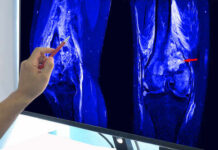
This is why two people with similar scans can live very different lives. One may have degeneration on imaging and little pain; another may have modest structural findings and disabling symptoms. The scan does not tell the whole story, because pain is not generated in bone, disc, or muscle alone. It is assembled by distributed circuits that include the thalamus, insula, anterior cingulate cortex, prefrontal cortex, amygdala, and brainstem systems that govern alarm, avoidance, and descending inhibition.[3][5][6]
That circuitry is not speculative philosophy. It is the basic architecture of pain biology. Peripheral tissue sends danger signals upward; the thalamus routes them; cortical and limbic regions assign meaning; and descending pathways can dampen or amplify the final output. In chronic pain, that balance often shifts toward amplification, especially when the person has learned to anticipate danger, movement, or recurrence.[5][7][8]
The New Neuroscience: Separating Sensation from Suffering
The most important advance in pain science over the last few years has been the tightening of circuit-level evidence. In mice, a corticothalamic circuit involving APC GABA neurons projecting to the mediodorsal thalamus bidirectionally regulated pain: activation reduced pain and induced freezing, while inhibition increased pain sensitivity and abolished fear-induced analgesia.[1] That matters because it shows that threat and pain are not merely correlated; they are mechanistically linked through identifiable neurons.
Another study from the Salk Institute identified thalamic CGRP neurons as a pathway that gives pain its emotional force. When those neurons were silenced, mice still detected mild pain, but they stopped showing learned fear and avoidance; when the neurons were activated, the animals displayed distress even without pain stimuli.[2] That is the clearest modern expression of the chronic-pain thesis: the nervous system can preserve sensation while still abolishing the suffering that makes pain disabling, or it can do the reverse and intensify suffering out of proportion to the original input.
Other circuits point in the same direction. The lateral parabrachial nucleus helps link pain, anxiety, and breathing, with distinct neuron populations contributing to defensive arousal and respiratory control.[3] The anterior cingulate-to-pontine pathway has been tied to placebo analgesia, with endogenous opioid signaling contributing to pain relief when relief is expected.[5][6] Taken together, these findings do not erase tissue injury; they show that the brain can gate, color, and prolong pain long after the original insult should have settled.
What the Evidence Does Not Support
The strongest mistake in popular chronic-pain discourse is to treat the brain-based model as a denial of peripheral disease. That is wrong. Chronic pain etiologies still include osteoarthritis, rheumatoid arthritis, lumbar radiculopathy, inflammatory disorders, mechanical injury, and other structural problems, and those diagnoses require tailored treatment.[9] A serious pain model must hold both truths at once: pathology can start the alarm, and the alarm can keep ringing after the tissue event no longer explains the severity.
The second mistake is to imagine that because the brain participates, medication becomes irrelevant. It does not. Clinical guidance still supports pharmacologic management in selected patients, including topical NSAIDs, lidocaine plasters for neuropathic pain when first-line therapies fail, and in some cases opioids for low back pain or osteoarthritis under careful review.[11] Modern non-opioid pharmacology is expanding as well, including agents such as suzetrigine, which has been discussed as offering analgesia comparable to hydrocodone-acetaminophen with a different side-effect and dependency profile.[13] The argument is not brain therapy versus medicine; it is smarter matching of mechanism to treatment.
Why Fear, Mood, and Attention Change Pain So Much
Pain and emotion are not parallel lanes; they are interlocking systems. In chronic pain, anxiety and depression are common because the same networks that register threat also process loss, vigilance, and inability to predict the body.[4][20] Functional and structural studies have repeatedly implicated the prefrontal cortex, thalamus, insula, amygdala, hippocampus, and nucleus accumbens in chronic pain states.[18][19][20] These areas govern salience, valuation, memory, and avoidance, which is why chronic pain often spreads beyond sensation into exhaustion, irritability, sleep disturbance, and learned incapacity.
This also explains why psychological interventions can be biologically serious. Cognitive-behavioral treatment has been associated with functional and structural brain changes, and pain-focused psychological treatments target the affective and cognitive dimensions of pain rather than pretending the body is irrelevant.[6][19] Pain reprocessing approaches and similar methods work by reducing the brain’s prediction of danger, interrupting the loop that says “this sensation means harm,” and helping the nervous system update its threat model.
Fear is especially potent because it prepares the organism for injury avoidance. In the short term, that is adaptive; in chronic pain, it can become self-defeating. The brain starts allocating more precision to threat, more attention to bodily sensation, and more avoidance of movement, which then weakens confidence, conditioning, and physical function. That is how pain becomes sticky. Not mystical. Learned.
What This Means for Treatment
The real clinical implication is precision. If a patient’s pain is dominated by inflammation, nerve compression, or degenerative mechanical disease, those drivers must be treated directly. If the pain persists after tissue healing, or if fear, catastrophizing, and avoidance have become central amplifiers, then the treatment plan has to include nervous-system retraining, graded exposure, sleep repair, and interventions that reduce threat appraisal.[1][2][5][9]
That is also why the best pain care is multidisciplinary. Drugs can reduce peripheral input or central excitability; procedures can relieve mechanical sources; psychotherapy can reduce threat learning and catastrophizing; rehabilitation can restore movement confidence; and education can prevent the disastrous error of equating abnormal imaging with inevitable disability.[6][11][19] In practice, these tools are complementary because chronic pain is not one mechanism with many names. It is many mechanisms converging on one experience. The lasting value of the neuroscience is not that it makes pain “less real.” It makes pain more intelligible.
Sources:
[1] Web – What’s Actually Driving Your Chronic Pain, From A Pain Psychologist
[2] Web – A corticothalamic circuit modulates pain sensitivity and mediates …
[3] Web – Scientists discover brain pathway that turns pain into suffering
[4] Web – Pain and anxiety are linked to breathing in mouse brains
[5] Web – Brain networking pain and anxiety: From basic mechanism to future …
[6] Web – Scientists find brain circuit for placebo pain relief – NIH
[7] Web – Neurobiologists Hack Brain Circuits Tied to Placebo Pain Relief
[8] Web – A brain circuit linking pain and breathing may offer a path to … – …
[9] Web – Scientists discover brain pathway linking pain to emotional distress
[11] Web – Chronic Pain – StatPearls – NCBI Bookshelf
[13] Web – Sociodemographic Differences in Pain Medication Usage … – Frontiers
[18] Web – [PDF] Table of Contents – Foundation For Health Care Quality
[19] Web – New brain circuit discovery offers hope for chronic pain relief
[20] Web – Brain Circuits Involved in the Development of Chronic … – Frontiers