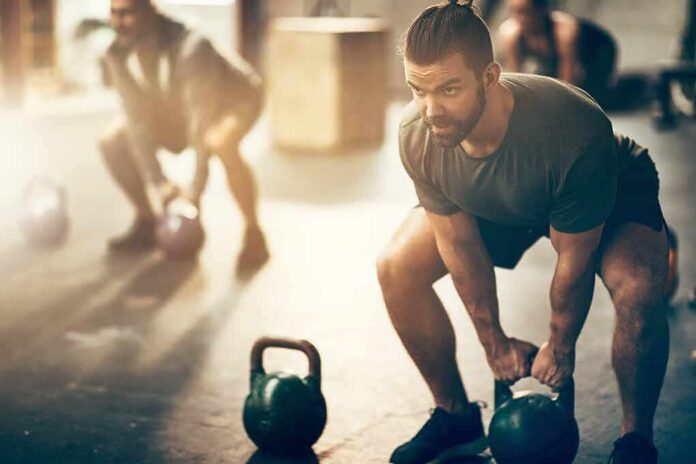
One exercise separates the fit from the injured, and it all comes down to hips, not arms.
Quick Take
- The kettlebell swing works when the hips drive the movement, not the shoulders or lower back.
- Men’s Health lays out a clear step-by-step form built on hip hinge, straight arms, and a neutral spine.
- Multiple outlets, including Healthline and The New York Times, agree on the same core mechanics.
- Research on swing biomechanics shows different styles load the body differently, but the hip-driven basics hold across all of them.
The Hip Hinge Is The Foundation, Not The Arms
Men’s Health built its kettlebell swing guide around one non-negotiable rule: the hips do the work. Lifters push their butt back, bend the knees slightly, and lean forward to grip the handle, letting the hamstrings and glutes load up before any pull happens. The arms stay relaxed. They exist only to hold the bell, not to muscle it upward.
That hinge pattern shows up everywhere in credible swing instruction, not just one source. Healthline’s version tells lifters to inhale, push the hips back, and bring the kettlebell between the legs while keeping the back straight. The repetition across outlets is not a coincidence. It reflects decades of strength coaching converging on the same safe, effective starting position.
Straight Arms And A Neutral Spine Prevent The Most Common Injuries
Once the kettlebell swings back between the legs, Men’s Health calls for an explosive hip snap forward, with the arms staying straight the entire time. The power comes from glutes and hips firing hard, not from curling or hoisting the weight with the shoulders. Trying to lift the bell with the arms turns a hip exercise into a shoulder strain waiting to happen.
Keeping the eyes on the floor and the spine neutral matters just as much as the arm position. Men’s Health warns lifters to avoid rounding or overextending the back during the swing. The Art of Manliness echoes this, noting the neck should stay slightly tucked and the back should remain neutral throughout the entire rep. Losing that spine position under load is where most kettlebell injuries start.
The Explosive Finish Separates A Swing From A Squat
The final piece of the movement is the aggressive glute squeeze at the top. Men’s Health describes propelling the kettlebell forward by exploding into a standing position and squeezing the glutes as hard as possible, not by lifting with the arms or upper body. That squeeze is what launches the bell to chest height using momentum instead of brute shoulder strength.
The New York Times’ technique guide backs this same sequence, instructing lifters to keep their shins vertical while pushing the hips back, then drive forward explosively. Today’s fitness team also frames the movement the same way, telling readers to hinge at the hips with elbows facing forward before swinging the bell back between the legs. Three separate outlets, one consistent blueprint.
What The Science Says About Different Swing Styles
Biomechanics researchers have measured how the hardstyle swing, the sport-style swing, and the overhead American swing each load the body differently. One study found cycle time for the overhead swing ran 34 percent longer than other styles, with distinct differences in ankle and joint loading. Another found that during a hardstyle swing, roughly 90 percent of the ground reaction force moves vertically, and that force scales with lifter skill level.
These differences do not contradict the basic form cues. They show that swing variants change how much force hits different joints, which is why coaches tweak endpoint height or arm path for different goals. The hip hinge, neutral spine, and glute-driven power stay constant no matter which style a lifter chooses.
Why Getting This Right Actually Matters
A kettlebell swing done with sloppy form is not just less effective. It shifts stress onto the lower back and shoulders, the two areas most likely to get hurt from repeated bad reps. Men’s Health frames the payoff plainly: fix the form, get the explosive gains, without the injury risk that comes from letting the arms take over the lift.
That is the real value of a guide like this. It is not complicated advice dressed up as science. It is a simple, repeatable checklist: hinge the hips, keep the spine neutral, keep the arms straight, and finish with an explosive squeeze. Lifters who follow that order get a stronger posterior chain and a lower injury bill.
The kettlebell swing has earned its reputation as one of the most efficient full-body exercises available, but only when the hips lead. Get that one detail right, and the rest of the movement falls into place.
Sources:
menshealth.com, today.com, nytimes.com, artofmanliness.com, m.riss.kr, eprints.chi.ac.uk, biorxiv.org