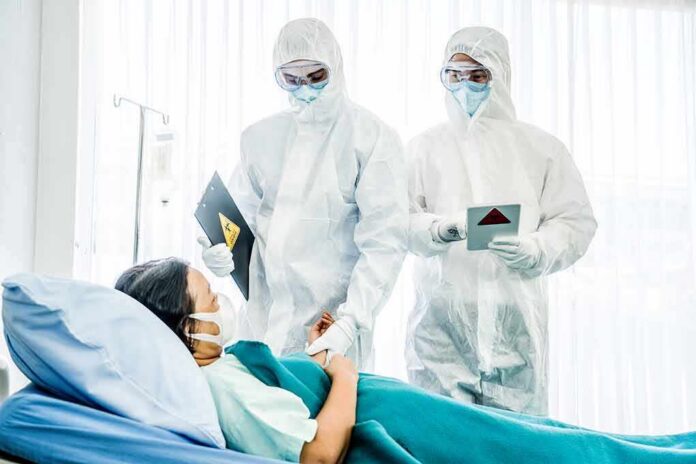
A doctor in a trial clinic became the first person ever to receive an experimental Bundibugyo Ebola vaccine, a milestone in the fight against an outbreak that has already killed hundreds across the Democratic Republic of the Congo and Uganda.
Quick Take
- The Bundibugyo Ebola outbreak is an active public health emergency with confirmed spread in the Democratic Republic of the Congo and Uganda.
- No approved vaccine or specific treatment exists yet for this rare Ebola strain, according to the World Health Organization (WHO) and other health agencies.
- A new vaccine candidate has now entered human testing, marking the first-ever trial dose given for this strain.
- Health officials warn the outbreak is spreading faster than containment teams can keep up.
- Security threats and weak health infrastructure in eastern Congo could slow both the outbreak response and the vaccine trial itself.
An Outbreak Without A Shield
The World Health Organization confirmed the Bundibugyo virus disease outbreak remains active, with case counts and deaths climbing steadily since May 2026. Unlike the more familiar Zaire strain of Ebola, Bundibugyo virus has no licensed vaccine or approved drug treatment. Doctors Without Borders says this gap forces responders back to basics: isolation, contact tracing, and safe burials, the same tools used decades ago before modern Ebola vaccines existed.
United Nations officials have described the outbreak in stark terms. Tedros Ghebreyesus, the WHO director-general, said the virus is spreading faster than health workers can contain it. That warning came after the World Health Organization declared the outbreak a public health emergency of international concern, a designation reserved for the most serious global health threats. The lack of any approved medical countermeasure has made this designation especially urgent for scientists racing to respond.
Against that backdrop, health authorities began discussing which vaccine candidates might be tested in emergency clinical trials. That discussion has now produced results. A trial site linked to Oxford University administered the first-ever dose of a Bundibugyo-specific vaccine candidate to a human volunteer, opening a new chapter in the outbreak response after months of case counts rising without any preventive tool available.
Why This Trial Matters Right Now
The stakes are high because the outbreak keeps growing. The Centers for Disease Control and Prevention (CDC) reported confirmed cases and deaths climbing week over week, with the World Health Organization tracking sustained transmission across both affected countries. Every week without a vaccine means health workers rely entirely on manual containment, a slow and labor-intensive strategy against a virus that spreads through contact with bodily fluids.
The European Union has flagged another problem: no fast, scalable diagnostic tools exist either, on top of the vaccine gap. That combination, no shot to prevent infection and no quick test to catch it early, makes the first human vaccine dose more than a symbolic moment. It represents the first real attempt to give doctors and communities something beyond quarantine and hope.
Still, a first dose is not proof of success. The trial is in its earliest stage, and public health agencies have not yet released detailed protocols, participant numbers, or safety data from this specific study. What’s confirmed is the broader emergency: WHO, CDC, and Doctors Without Borders all agree no approved vaccine currently exists for Bundibugyo virus disease, which is precisely why this trial was launched at all.
Ground Realities Slowing The Response
Getting a vaccine tested and rolled out in eastern Congo is not like running a trial in a controlled American hospital. United Nations relief officials have pressed for faster global action, warning that the response effort itself needs to move quicker than it has. Security instability, damaged roads, and fragile local health systems all complicate follow-up visits and data collection for any clinical trial in the region.
American health officials have stressed there’s no current threat to the United States, with the CDC confirming no domestic cases linked to this outbreak so far. But the global stakes remain real. A successful vaccine trial in the heart of the outbreak zone could eventually protect health workers, family caregivers, and vulnerable communities who have had no medical shield against this virus until now. That’s a goal worth watching closely as more data comes in.
Sources:
insiderpaper.com, who.int, news.un.org, msf.org, eeas.europa.eu, cdc.gov, reliefweb.int