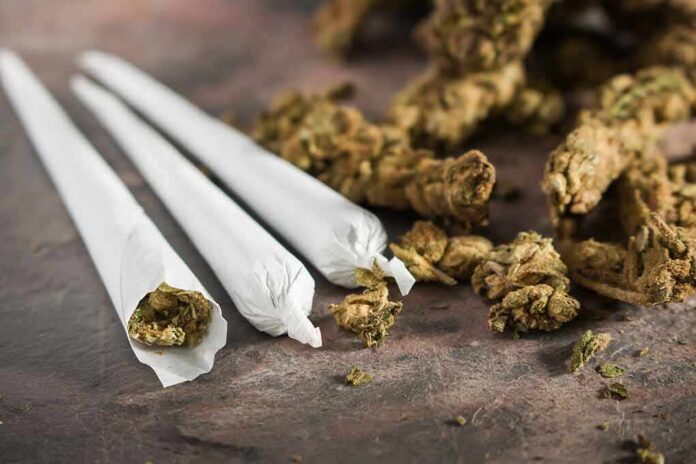
A massive new study of more than 415,000 Americans found that people with cannabis use disorder had 57% higher odds of thinking about suicide in the past year.
Quick Take
- Researchers tracked 415,861 U.S. adults using national survey data collected from 2014 through 2023.
- Adults with cannabis use disorder showed 57% higher odds of past-year suicidal thoughts, a statistically solid finding.
- The risk pattern held steady across all ten years studied, not just one survey period.
- The study shows a strong link, not proof that cannabis use disorder causes suicidal thoughts.
A Decade Of Data Points To The Same Warning Sign
The study comes from Oyetunji, Chan-Golston, Ha, and Goldman-Mellor, published in the Journal of Studies on Alcohol and Drugs. Their team pulled records from the National Surveys on Drug Use and Health, built from interviews with hundreds of thousands of adults over nearly ten years. That scale gives the finding real weight. This isn’t a small clinical sample or a handful of case reports. It’s a broad snapshot of American adults answering the same questions year after year.
The core number is an odds ratio of 1.57, with a confidence range of 1.44 to 1.72. In plain terms, adults who met the criteria for cannabis use disorder were notably more likely to report suicidal thoughts than adults who didn’t. The researchers adjusted their math for demographic background, social factors, clinical history, and geography, which strengthens the comparison beyond a raw, unadjusted count.
How Researchers Defined A Disorder, Not Just Casual Use
This study did not lump in every person who smokes marijuana occasionally. Cannabis use disorder was defined using at least two of nine criteria drawn from the American Psychiatric Association’s diagnostic manual, the same framework doctors use for other addictions. That distinction matters. The finding is about a diagnosable pattern of dependency and impairment, not recreational use on a weekend.
The link also proved remarkably steady. Researchers ran a statistical test checking whether the strength of the connection shifted across the ten-year window, as cannabis legalization spread and potency climbed in many states. It didn’t change in any significant way. The association between cannabis use disorder and suicidal thoughts looked about the same in 2014 as it did in 2023.
What The Study Can And Cannot Prove
The research measured suicidal thoughts, not suicide attempts or deaths. That’s an important boundary. Thinking about suicide is a serious warning sign doctors take seriously, but it’s a different outcome than an attempt or a fatality, and this study can’t be stretched to cover those outcomes directly.
The design itself also limits what can be claimed. Researchers surveyed people at single points in time rather than following the same individuals for years. That means they can’t say whether cannabis use disorder came first, whether suicidal thoughts came first, or whether something else entirely, like untreated depression or trauma, drove both. The authors themselves stopped short of calling it causation, describing an association instead.
Placing The Finding Inside A Larger Body Of Research
This study joins a long list of findings pointing the same direction. A 2017 National Academies review concluded there was moderate evidence linking cannabis use to suicidal thoughts and attempts, with heavier users showing higher odds. That earlier review flagged the same caveats researchers raise now: self-reported data, limited follow-up, and the difficulty of ruling out other causes.
Other reviews have found mixed results depending on the population studied, which is part of why scientists keep returning to this question instead of treating it as settled. Still, the consistent theme across a decade of work is that heavier, disorder-level cannabis use keeps showing up alongside higher suicidal thinking, even as researchers debate exactly why.
New study of 415,000+ Americans links cannabis use disorder to 57% higher odds of suicidal thoughts:https://t.co/xWLjeo7fGw #Tech #Health
— Semasocial.com (@semasocial) November 17, 2026
For parents, doctors, and lawmakers watching cannabis policy evolve state by state, this study offers a clear, data-backed signal worth taking seriously. It doesn’t settle the debate over legalization, and it shouldn’t be twisted into a claim the study doesn’t make. But it adds real weight to concerns that cannabis use disorder deserves the same clinical attention as other addictions, especially where mental health is involved.
Sources:
sciencedaily.com, sites.ucmerced.edu