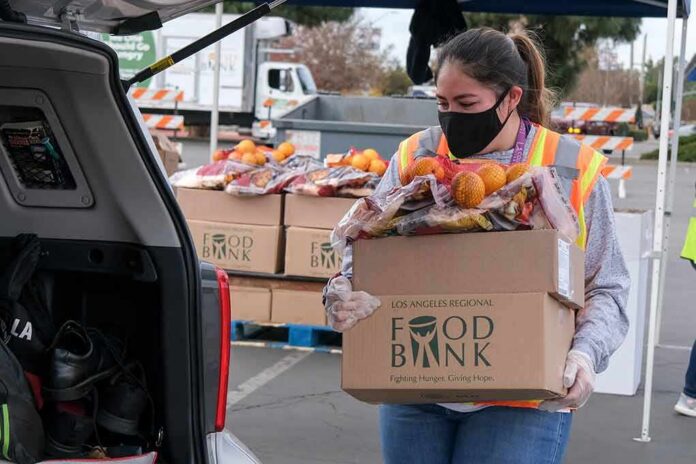
Nearly one in four middle-income American families ran short on food money last year, and the food banks meant to help them are stretched thinner than ever.
Quick Take
- USDA data show 18.3 million U.S. households, or 13.7% of all households, faced food insecurity at some point in 2024.
- About half of surveyed food banks reported a 15% jump in people served over the past year.
- The Capital Area Food Bank found one in four middle-income families struggled to get enough food.
- Food bank leaders warn that cuts to federal food aid could push even more families to seek help.
The National Numbers Behind the Hunger Surge
The U.S. Department of Agriculture tracks food insecurity every year through a national survey. The newest report counts 47.9 million people living in food-insecure households in 2024. That means these households lacked enough money or resources at some point to reliably get the food they needed. The number has stayed roughly flat since 2022, but it remains well above pre-pandemic levels.
That federal survey measures something specific. It asks households whether they had steady access to enough food, not whether they walked into a pantry to get it. Food bank demand is tracked separately, by the organizations that run the pantries themselves. Both measures point the same direction right now, but they are not interchangeable snapshots of the same crisis.
Middle-Class Families Are the New Faces in Pantry Lines
Food banks are reporting a shift in who shows up for help. The Capital Area Food Bank’s annual Hunger Report found that one in four middle-income families experienced food insecurity over the past year. That is a striking number, because middle-income households are not who most people picture when they think of hunger relief. Higher rent, child care costs, and grocery prices have squeezed paychecks that used to stretch further.
Nationally, the strain is showing up in raw volume. About half of the food banks surveyed by Feeding America reported an average 15% increase in the number of people they served compared with the year before. That is not a small bump. For pantries already working with tight shelves and volunteer staff, a 15% jump in visitors means longer lines, faster-emptying shelves, and harder choices about what to hand out.
SNAP Cuts Could Push Even More People Toward Food Banks
Food banks were never built to replace the Supplemental Nutrition Assistance Program, known as SNAP. Feeding America says SNAP provides nine meals for every single meal a food bank can supply. That ratio explains why food bank directors are bracing hard for anticipated SNAP reductions. Amanda McCarthy, executive director of the River City Food Bank, expects more first-time visitors and heavier demand for produce, protein, baby formula, and diapers once the cuts take hold.
That expectation has not yet become a measured outcome. It is a forecast from people running the pantries day to day, based on what they have seen happen before when federal food aid shrank. If SNAP benefits drop for a large group of recipients, food banks say they will be the first stop for families trying to close the gap. Whether that plays out exactly as predicted will depend on how the cuts are actually implemented.
Two Measures, One Growing Strain on American Families
Government surveys and food bank reports are both pointing toward real hardship, even though they count different things. The USDA tracks household-level food security across the whole country using a standardized survey. Food banks track their own foot traffic and inventory, locally and in real time. Together, they paint a picture of a system under pressure from two directions: more families struggling to afford groceries, and the charitable network built to help them absorbing more of the load.
Charting the Essentials, a USDA data series on food and nutrition assistance, shows that these pressures tend to track with broader economic conditions like food prices and housing costs. That history suggests the current numbers are not an isolated blip. Families earning steady paychecks are increasingly finding that those paychecks don’t stretch as far at the grocery store, and the organizations built to catch people falling through the cracks are feeling the weight of that shift firsthand.
For now, the trend lines agree: more households need help, and the places built to give it are working harder than they have in years to keep up.
Sources:
youtube.com, ers.usda.gov, feedingamerica.org