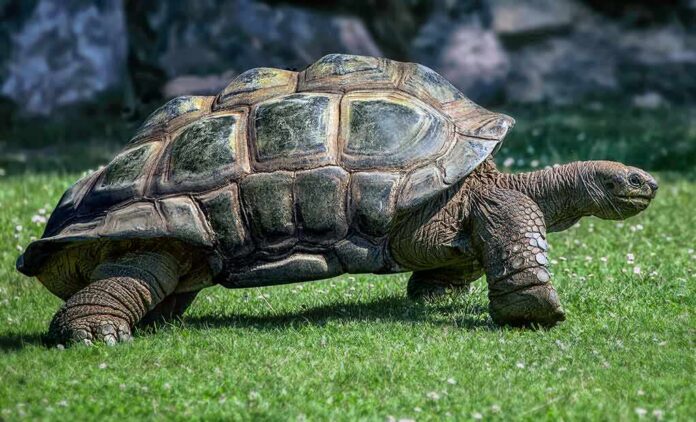
Jonathan the tortoise has outlived every human who has ever studied him, and scientists just found out why his cells refuse to quit.
Quick Take
- Jonathan, a 194-year-old Aldabra giant tortoise living on Saint Helena, had his full genome and methylome sequenced for the first time.
- Researchers found 287 genes with variants unique to Jonathan, many tied to DNA repair, telomere maintenance, and mitochondrial energy production.
- His mitochondrial gene regulation looked unusually “orderly,” resembling patterns seen in much younger animals.
- Scientists used a cheek swab instead of a blood draw to protect the elderly, legally safeguarded tortoise.
- The findings are published in a peer-reviewed study, but they describe genetic patterns in one tortoise, not a proven human anti-aging treatment.
A 194-Year-Old Tortoise Gets The Genetic Deep Dive
Jonathan lives on the remote South Atlantic island of Saint Helena and holds the title of oldest known living land animal. Researchers sequenced his genome and methylome, the chemical tags that control which genes turn on or off, to understand how his body has held together for nearly two centuries. The study appeared in Science Advances, giving the public its first detailed molecular look inside a tortoise this old.
Scientists could not draw blood from Jonathan because of his age and protected status. Instead, they collected a cheek swab, a far gentler method that still provided enough genetic material for full genome and methylome analysis. That workaround itself says something about how carefully researchers treated this animal, balancing scientific curiosity with basic respect for a creature old enough to have been alive during the Civil War.
What The 287 Unique Genes Actually Show
The research team identified 287 genes containing variants found only in Jonathan, none shared with the other tortoises studied. Many of these genes sit inside pathways linked to DNA repair and telomere maintenance, the protective caps on chromosomes that usually fray with age, according to University of Cambridge and Scientific American summaries of the work. That pattern suggests his cells may have extra tools for patching up genetic damage over time.
Jonathan’s epigenetic profile also stood out. Promoters controlling mitochondrial energy production, the part of the cell that generates power, showed unusually low “methylation entropy,” essentially meaning the regulatory instructions stayed clean and orderly instead of growing messy with age, according to Vanderbilt University Medical Center’s review of the findings. Researchers tied that orderliness to high-fidelity gene expression in mitochondrial and RNA-processing pathways, the kind of steady cellular bookkeeping that tends to break down in aging humans.
Comparing Jonathan To Other Giant Tortoises
Scientists didn’t study Jonathan alone. They compared his genome against other Aldabra giant tortoises and against Lonesome George, the famous last member of his own Galápagos tortoise subspecies, with The Scientist noting comparisons spanned animals from a five-year-old juvenile to older adults. To check whether the 287 variants might actually change how proteins function, researchers ran them through AlphaFold2, a structural modeling tool, generating predicted protein shapes for every one of those genes and their Lonesome George counterparts.
This fits a pattern seen in earlier tortoise genomics. A 2018 study of giant tortoise genomes similarly found lineage-specific variants affecting DNA repair genes, inflammatory mediators, and cancer-related genes, framing them as candidate evolutionary strategies rather than proven individual causes of long life. Galápagos tortoise research has reported related trends toward large bodies, long lifespans, and reduced cancer risk across multiple turtle lineages, reinforcing that longevity biology in these animals runs deeper than one famous individual.
Why This Matters Beyond One Remarkable Tortoise
The study gives science a genuine, peer-reviewed data point on extreme longevity, built from real sequencing work rather than guesswork. One brief caveat matters here: Jonathan represents a single living animal, so the study shows association between his variants and his age, not proof that those variants caused his survival. That’s a responsible scientific limit, not a weakness in what was actually measured.
🐢 A 194-year-old tortoise is revealing how to age slowly
Jonathan, an Aldabra giant tortoise believed to have hatched in 1832, is the oldest known living land animal. In a study published in Science Advances, researchers found his epigenome — the system controlling which genes… pic.twitter.com/YwaDppvVxJ
— Ankit V (@AnkitV252) November 23, 2026
Researchers now have a clear roadmap: sequence more Aldabra tortoises across different ages, run functional lab tests on the 287 candidate genes, and measure mitochondrial performance directly against controls. Until that work happens, Jonathan’s genome stands as a fascinating clue, not a finished anti-aging formula. For readers hoping tortoise DNA holds a shortcut to 150, the honest answer is that nature rarely hands over its secrets that easily.
Sources:
sciencedaily.com, cnn.com, gizmodo.com, scientificinquirer.com, scientificamerican.com, science.org, 404media.co