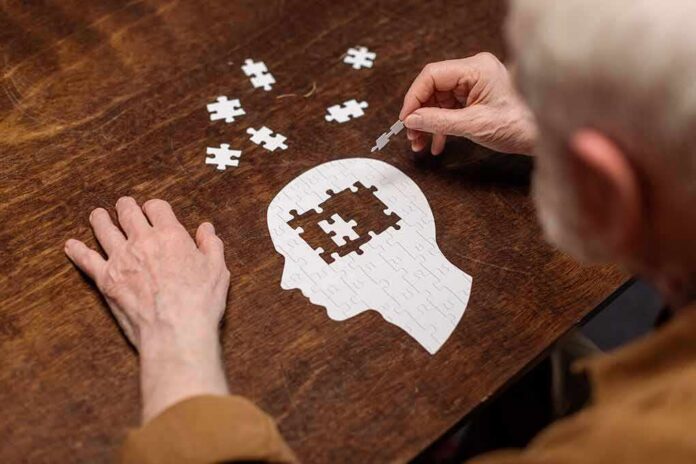
A neurology expert says puzzles switch on a web of brain systems at once—and the data backs up key parts of that claim.
Story Snapshot
- Puzzles engage memory, attention, and spatial skills in real time.
- Regular puzzlers often show sharper thinking as they age.
- Crosswords can outperform some “brain game” apps in mild impairment.
- Puzzles help, but they are not a stand-alone shield against dementia.
What the Neurology Expert Actually Claims
The on-record video frames puzzles as a spark for many brain systems at once. It states that jigsaw building lights up eight cognitive functions, and that puzzles trigger a complex chain of brain events. That framing aligns with lab work showing jigsaw puzzling taps multiple visuospatial abilities—like mental rotation, part-whole reasoning, and visual memory. The core idea is not hype: real tasks demand real networks. The question that matters next is what those activated networks mean for long-term brain health.
Evidence from older adults shows a link between puzzling and sharper thinking. Large online cohorts report that frequent word and number puzzlers score higher on tests of attention, reasoning, and memory compared to peers who puzzle less. Researchers who analyzed these data did not promise a cure-all; they described sharper function in people who practice often. That is a sensible pattern. Any skill you train tends to improve. The key is how far that benefit travels into real life.
Short-Term Gains Versus Lasting Protection
Clinical trials help make that call. A study in NEJM Evidence reported that crosswords beat a popular set of computerized cognitive games on a standard memory scale in older adults with mild cognitive impairment, with advantages at 12 and 78 weeks and signals of less brain atrophy. That is a meaningful head-to-head win for a low-tech tool. Still, a broad review in a top internal medicine journal found insufficient evidence that cognitive training prevents cognitive decline or dementia across the board. Gains can be real yet limited.
Researchers who track puzzling and aging often use careful language. They report associations between puzzling and delayed memory decline onsets in observational studies, or better test scores in habitual puzzlers, but stop short of medical guarantees. That restraint reflects common sense and conservative values: do what helps and costs little, but do not oversell. Puzzles train the brain you use. Benefits appear strongest when the task challenges you and you stay consistent.
What Actually Fires in Your Brain When You Puzzle
Building a jigsaw recruits visual scanning, edge detection, and feature matching. It tests working memory as you hold image fragments in mind. It leans on attention control to ignore false fits. It taps planning when you sort by color, shape, or pattern. These are not vague claims; controlled experiments confirm that jigsaw puzzling draws on visuospatial cognition and related skills. Word and number puzzles flex language networks, pattern recognition, and processing speed, which matches why regular players often perform better on these exact skills in testing.
Two truths can coexist. First, puzzles can sharpen targeted skills and sometimes outperform flashy apps in people with mild impairment. Second, the best current summary still says puzzles alone do not prevent dementia for the average person. The smartest plan treats puzzles as one pillar in a basic brain-health stack: move your body, sleep on schedule, eat whole foods, connect with people, manage blood pressure and blood sugar, and keep learning. That full package lines up with everyday prudence and the weight of evidence.
How to Use Puzzles the Right Way
Pick puzzles that make you think, not yawn. Rotate types—jigsaws, crosswords, logic, and number grids—to hit different skills. Nudge difficulty up as you improve. Set a short daily window you can keep. Track progress by how often you feel a true challenge, not by streak length. Treat apps as tools, not magic. If you already live with mild cognitive issues, consider structured crosswords, given their trial edge against certain digital games in memory outcomes. Keep your goals humble and your habits steady.
Sources:
youtube.com, pmc.ncbi.nlm.nih.gov, stories.tamu.edu, sciencedaily.com, acpjournals.org